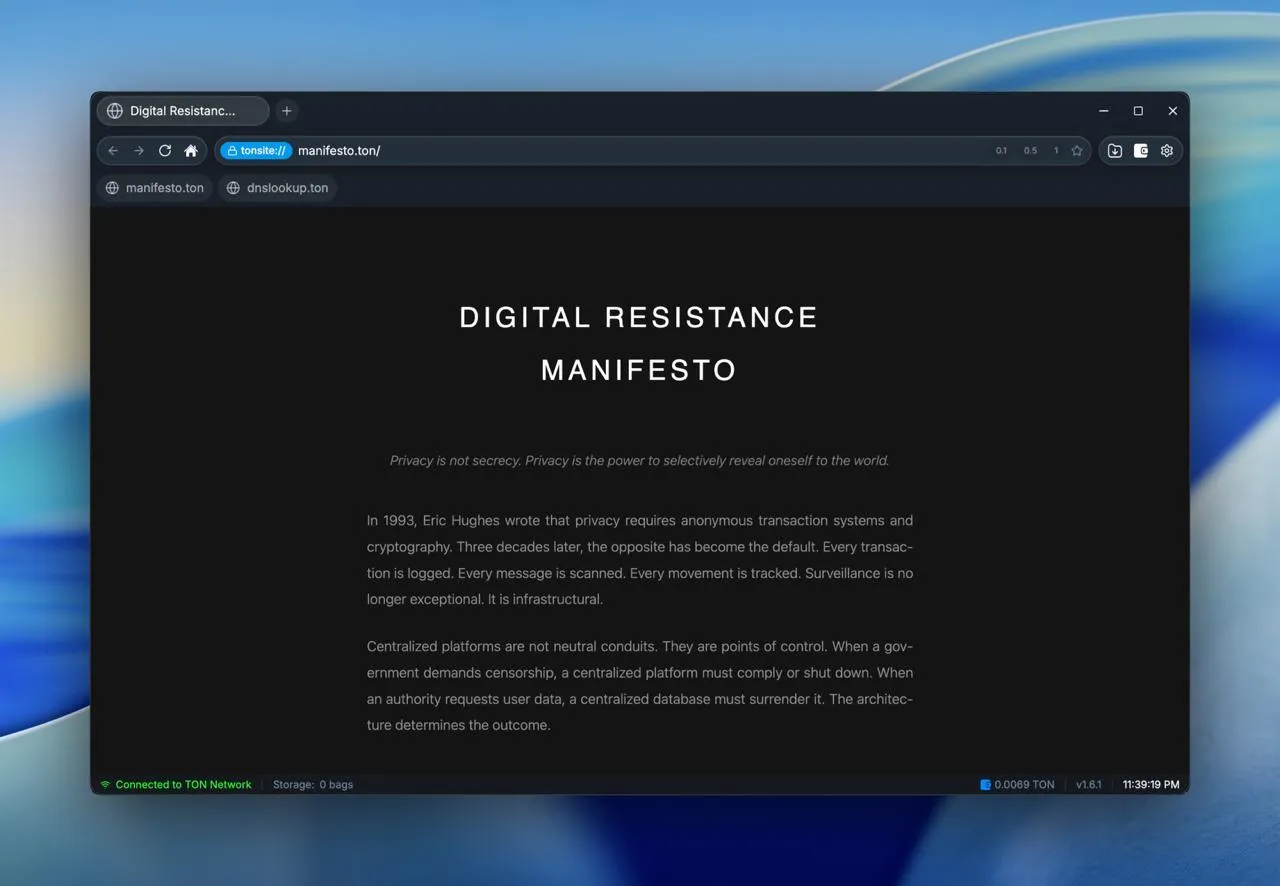
Let’s talk about manifesto.ton. It’s the text we wrote to state what Digital Resistance is doing on TON, and why it had to be written down now.
Why a manifesto
We’ve been shipping tools for a year without explaining the bigger picture. Tonnet, the gateways, the storage bots, the .ton sites, the proxies. Each project speaks for itself, but the line connecting them does not. The manifesto draws that line.
It says one thing: censorship-resistance has to be the default of an internet, not a feature bolted on later.
The bet on TON
TON ships layers for hosting, naming, storage, routing, and payments. Domains live on-chain as NFTs, files are shared peer-to-peer across nodes, and requests reach the network directly or route through nodes for anonymity. Web3 sites and apps run on top, and smart contracts execute publicly and immutably. That’s the stack we build on.
The strategy is borrowed
The cypherpunks did this in the 90s. They wrote PGP, ran remailers, designed digital cash, deployed code instead of arguing for policy.
Pavel Durov did the same in 2018. When Russia banned Telegram, he funded hundreds of proxies out of pocket. Two years later the ban was lifted. He called the operation Digital Resistance. We’re picking up the name on TON.
Read it
manifesto.ton.resistance.dog (HTTPS gateway)
manifesto.ton (native, requires Tonnet or xssnick/tonutils-proxy)
Keep resisting.